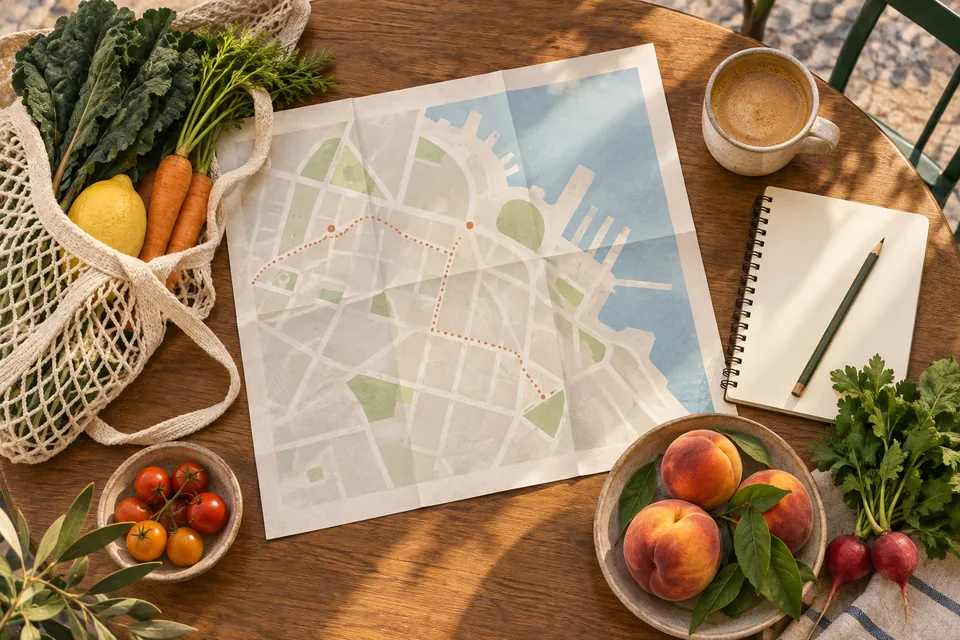
A food walk at Adelaide Central Market works best as a way of paying attention, not as a prescribed tasting challenge. The Market is made up of independent traders, so a useful route must leave room for changing availability, personal appetite and the conversations that happen at a stall. Start with the official Market map (opens in a new tab) and use it to identify the building's shape, entrances and broad areas. Then decide on two or three food categories that genuinely interest you instead of trying to sample everything.
Build a route around curiosity, not a checklist
The official trader directory (opens in a new tab) is the right place to look for current stall details before arriving. It groups a broad range of food businesses, including fruit and vegetables, bakery and patisserie, pantry and speciality items, deli, meat and poultry, seafood, cheese and dairy, coffee and confectionery, and eateries and cafés. Use those categories as prompts rather than promises: perhaps begin with something fresh, compare one pantry item or baked good, and finish with a seated pause. A short route that leaves space to ask questions is more useful than a long list of named stops that may not suit the day.
A small notebook or phone note can help turn the visit into a practical walk. Record an ingredient, a producer or a cooking idea you would like to return to. If buying food to take away, bring a bag and keep the journey back to accommodation in mind. If the visit is mainly for eating, decide whether you want a quick bite or a slower stop before you arrive, then let the Market's current offerings guide the rest.
Use the map twice
The first use of the map is orientation. The second is a reset after the initial circuit. After walking through once, return to the parts that held your attention rather than following the same path again. The official FAQs (opens in a new tab) also say physical copies are available at the Market Stall at the central Gouger Street entrance. That stall can provide Market, trader and product information, which is helpful when a detail has changed or a particular kind of food is the priority.
Do not confuse a self-guided food walk with an official Market tour. The FAQs state that the Market does not operate tours itself, while noting that third-party operators may offer their own. This guide is therefore a flexible way to explore the public Market using its own planning tools, not a substitute for an independently booked tour or a claim that a particular tasting is included.
Choose the right trading day
Current trading runs Tuesday to Saturday, with an optional Wednesday trading day. On Wednesday, not all stalls are required to open; the Market recommends contacting an individual trader directly when that matters. Check the official information close to the visit, especially for a favourite stall, a dietary need or a specific purchase. That small preparation is more valuable than building an itinerary around a listing that may have changed.
A relaxed food walk can take the shape of one considered loop: orient with the map, choose a few categories, pause to talk with traders where appropriate, then return to the things you genuinely want to buy or try. It is a way to make the Market legible on your own terms while respecting that its daily offer is alive and variable.
Sources
Sources last validated: 14 September 2026.